
Have you only just discovered there are two types of toilet trap – and now you’re wondering if you’ve somehow been living with the inferior one this whole time? It’s a fair concern. Nobody wants to be quietly putting up with a worse-performing toilet just because that’s what came with the house. So let’s lay out the actual difference between an S trap vs P trap toilet – and then work through what genuinely determines whether one suits your situation better than the other.
First, what are we even talking about?
Every toilet has a ‘trap’ – the curved section of pipe that holds a small amount of water to form a seal, stopping sewer gas from drifting back up into your bathroom. It’s a clever, low-tech bit of design, and it’s been doing its quiet job in bathrooms for over a century.
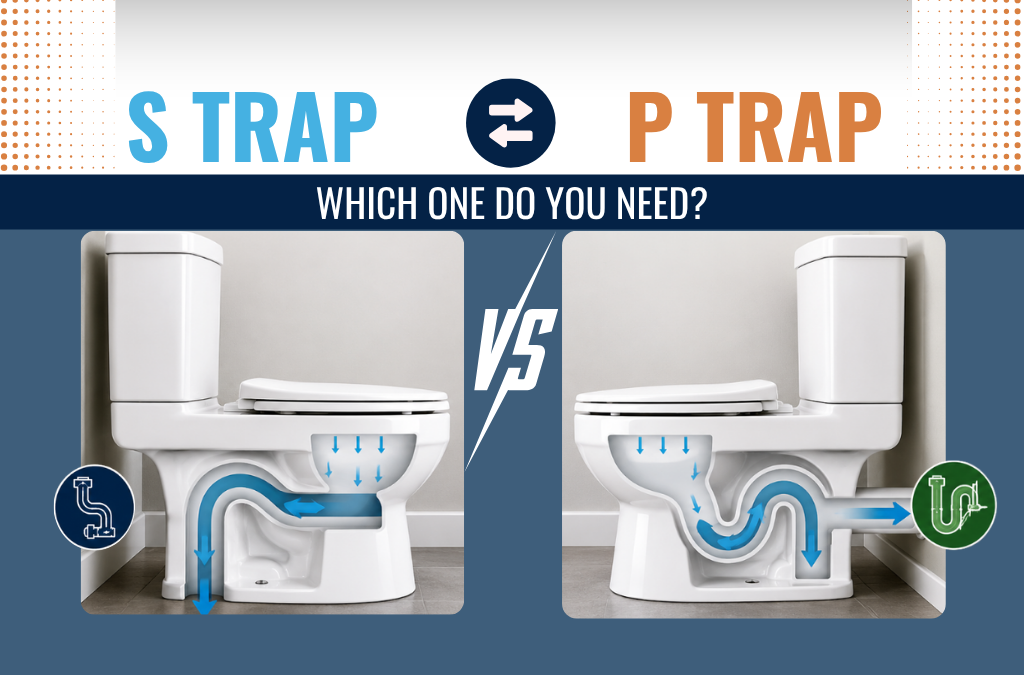
The difference between S trap vs P trap toilet setups comes down to one thing: which direction the waste pipe exits the toilet.
- An S-trap exits straight down through the floor, curving into an S shape on its way.
- A P-trap exits horizontally out the back of the pan and into the wall, forming a P shape when viewed from the side.
So in the grand scheme of things in the P trap vs S trap debate, that’s genuinely how it works. Same job, different exit direction.
Where you’ll typically find each one
S-traps are the standard in older Australian homes – particularly anything built before the 2000s, where plumbing was run beneath the floor or through a concrete slab. If you walk into a heritage terrace or an older suburban bathroom and see the waste pipe disappearing straight down into the floor behind the pan, that’s your S-trap.
P-traps have become the standard in newer builds, as well as apartments and multi-storey construction – where running waste pipes through wall cavities makes more practical sense than tunnelling through a slab. That’s especially the case on upper floors, where there’s no floor below to run pipework through anyway.
S trap VS P trap – Which is better?
Here’s where S-trap vs T-trap toilet configurations gets a bit nuanced – and depending on who you ask, you’ll get one of two honest answers.
Some will say “neither is better – it depends on your plumbing”. And, realistically, the trap type your toilet needs really is dictated by how your existing waste pipe is configured – floor outlet or wall outlet.
You can’t simply decide you’d prefer a P-trap and bolt one onto a floor outlet without significant plumbing work. In this sense, is the wrong question entirely – the right one is “which one matches what I’ve already got.”
However, others in the P trap vs S trap toilet debate will tell you that – generally – a P-trap is now the way to go. Because when you ask plumbers which they’d choose given a genuine choice – say, during a full renovation where the outlet position itself is up for discussion – most lean P-trap.
The reason? It comes down to one specific issue: siphoning.
The siphoning problem
An S-trap’s vertical drop can, under certain conditions, create a siphoning effect during flushing that pulls water out of the trap’s seal. When that happens, the water barrier that’s supposed to block sewer gas thins out or empties – and that’s when bathrooms start smelling like something’s gone wrong, because something has.
The good news: a properly vented S-trap shouldn’t have this problem at all. Correct venting equalises the pressure and prevents the siphoning effect from happening in the first place.
The bad news: a lot of older Australian homes don’t have ideal venting set up, which is exactly why S-traps have picked up a slightly worse reputation over the decades – not because the design is inherently flawed, but because plenty of real-world installations weren’t vented as well as they should have been.
P-traps are less prone to this siphoning issue by design, which is part of why they’ve become the preferred standard in current Australian plumbing codes for new construction.
3 Other factors worth knowing
Beyond the siphoning issue, a few smaller but genuinely practical differences are worth having at the back of your mind.
1. Blockage access
S-traps can be slightly more annoying to clear when blocked, since the obstruction sits down at the bottom of the floor bend in a spot that’s trickier to reach with a plunger or drain snake than a horizontal P-trap connection.
2. Renovation flexibility
If you’re renovating and the outlet position isn’t fixed yet, a P-trap configuration generally gives a cleaner, more streamlined look with less visible pipework – purely an aesthetic bonus on top of the siphoning advantage.
3. Converting between the two
Yes, it’s possible to convert from one to the other, but it’s genuine plumbing work involving:
- Cutting into floor or wall
- Rerouting the waste line
- Resealing everything to a watertight, gas-tight standard.
It’s certainly not a weekend DIY swap, and it’s not something to attempt without a licensed plumber.
So which one do you actually need?
What if you’re simply replacing an existing toilet? Does that change anything about P trap vs S trap plumbing? The honest answer is that whichever one matches your current outlet is the one to go for.
There’s no upgrade to chase here if your plumbing is fixed in place – buying the wrong trap type for your existing setup just means an expensive return or a costly retrofit.
If you’re in the middle of a genuine renovation where the outlet itself is up for discussion, a P-trap is the generally preferred option among plumbers, mainly for its reduced siphoning risk and compatibility with modern Australian plumbing codes.
Not sure your trap is performing properly?
Need to know more about the S-trap vs P-trap distinction? Brisbane Drain Cleaning‘s licensed plumbers can identify your existing trap configuration – and while we’re at it, check your venting and advise honestly on whether your current setup needs anything more than a straightforward toilet swap.
Give us a try today by calling the friendly team or booking online.
Related posts:
 What Is A Boundary Trap? 5 Ways It Can Cause A Sewer Blockage
 Are Flushable Wipes Actually Flushable? 5 Ways They Damage Plumbing
 7 Ways On How To Get Rid Of Smelly Drains In Bathroom
 How To Get Rid Of Drain Flies In 5 Different Ways
 Toilet Draining Slowly? Here’s How To Fix It
 How To Unblock A Toilet CALMLY: The Clog Psychology
