
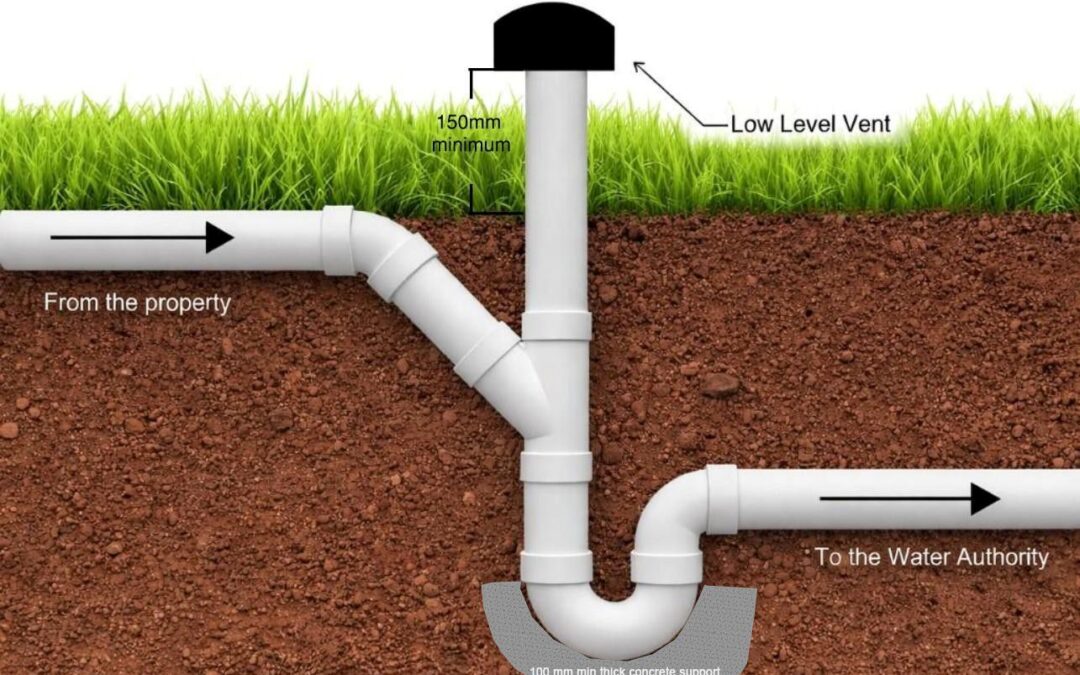
Image Source: https://www.vba.vic.gov.au/plumbing/dr-09-drainage-overflow-relief
Did you know there’s a piece of plumbing infrastructure sitting somewhere on your property right now that you’ve probably never heard of, couldn’t locate if you tried, and only find out about if you either read this blog or when something goes horribly wrong? It’s the boundary trap – and we’re about to take a deep dive.
A boundary trap is one of those things that quietly does its job for years – and probably even decades – until it gives up. And when it does, it tends to make its failure known in the least pleasant way possible. Because nobody – literally nobody – wants sewerage anywhere other than exactly where it’s supposed to be.
Today, we’re going to explore:
- What a boundary trap even is
- Why it exists in the first place
- The ways it can cause a horrible sewer blockage.
What is a boundary trap?
So … first things first.
A boundary trap is a U-shaped fitting installed in the sewer line at or near the property boundary – typically where your private sewer connects to the council’s sewer main.
Its job is to act as a water seal between the two systems, preventing sewer gases from the council main from travelling back up through your private plumbing and into your home.
Think of it like the P-trap under your sink … but for your entire sewer system.
- The U-shape holds the water
- The water blocks the gas
- The whole arrangement keeps the air inside your home smelling like a home rather than a sewer.
Boundary trap plumbing is a feature of older Queensland properties – particularly homes built before the 1980s, when the design standard changed and the trap requirement was phased out in new builds.
If your Brisbane home is older and hasn’t had significant sewer work done, there’s a reasonable chance you have one.
A sewer boundary trap also typically includes a vent – a boundary trap vent that extends above ground to allow the system to breathe and prevent pressure buildup.
But we’ll get back to why that matters so much shortly. Because you need to understand all the ways a boundary trap can cause a horrific sewer blockage at your place:
5 Ways a boundary trap can cause a sewer blockage
Boundary traps are functional by design – but they come with a set of vulnerabilities that make them a disproportionately common source of sewer blockage problems in older Brisbane properties.
Here’s how it happens.
1. The trap fills with debris and blocks entirely
The U-shape that makes a boundary trap useful is also what makes it a debris collector.
You probably already know, but all of these travel down your sewer line:
- Grease
- Wipes
- Hair
- Grit
- Sediment.
What they all have in common is that they slow down when they hit the curve of the trap. And over years and years – even decades – that material accumulates.
The trap then narrows. The flow slows. And – eventually – the blockage is complete.
This is the most common boundary trap blockage scenario, and it’s almost entirely a function of age and what’s been put down the drains over the life of the property. It’s not a design flaw exactly – it’s just what happens to a U-shaped fitting that’s been sitting underground for 40 years!
2. Tree roots find their way in
Sewer lines and tree roots have a long and unhappy history, and the boundary trap is no exception.
It’s important to realise that the joints around an older trap are often the first point of entry:
- Roots detect moisture
- They push into the joint gap
- They establish themselves inside the fitting where they grow until flow is restricted or blocked entirely.
In Brisbane’s established suburbs, where mature trees and old clay sewer lines coexist across thousands of properties, tree root intrusion into a boundary trap sewer fitting is a routine finding on a CCTV drain inspection. It’s fixable, but it’s also recurring – roots come back unless the underlying pipe damage is addressed.
3. The vent pipe blocks or fails
A boundary trap vent is designed to allow air into the system to prevent siphoning – without it, the water seal in the trap gets sucked out by negative pressure, which defeats the whole purpose of having the trap in the first place.
Unfortunately, the vent pipe is prone to becoming blocked by:
- Debris
- A bird’s nest
- Or simply by deteriorating and collapsing.
Either way, the trap will start to behave erratically. Drains slow, gurgling sounds appear at fixtures, and the system becomes more prone to blockage because the pressure dynamics inside the line are no longer working as intended.
4. The trap itself deteriorates and partially collapses
Older boundary traps are typically made from clay or cast iron. Both deteriorate. Clay becomes brittle and cracks. Cast iron corrodes.
And when the structure of the trap itself starts to fail, the internal profile changes – sections collapse inward, the flow path narrows, and what was a functional fitting becomes an obstruction.
This is where boundary trap replacement enters the picture. A trap that’s structurally compromised can’t be cleared and returned to full function – the fitting itself needs to come out and be replaced with a modern equivalent.
Boundary trap replacement cost varies depending on depth, access, and what the surrounding pipework looks like, but it’s a known and manageable job for a licensed plumber.
5. The trap is undersized for current usage
Boundary traps were sized for the properties they were originally installed in – which in many cases were smaller households with significantly lower water usage than the same property today.
So if your home was renovated, now has multiple bathrooms and a modern kitchen and heavy daily use is working harder than it was designed for, that older trap may no longer be coping with its task. And over time, that mismatch contributes to chronic slow drainage and recurring partial blockages that clear temporarily and return.
How do you know if your boundary trap is the problem?
The honest answer is that you often can’t tell from the surface.
However, you may be noticing:
- Recurring sewer blockages that clear and come back
- Slow drainage across multiple fixtures
- Gurgling sounds
- Sewage smells in the yard.
They’re all consistent with a boundary trap issue – but they’re also consistent with other sewer problems further down the line.
A CCTV drain camera inspection is the definitive diagnostic tool that will settle the uncertainty. The camera goes into the line and shows exactly what’s in there and where – including the condition of the boundary trap, any root intrusion, and whether the fitting is structurally sound or approaching the end of its life.
Brisbane Drain Cleaning & boundary trap issues
When it comes to your property’s boundary trap, we do it all:
- Inspections
- Clearing
- Full boundary trap replacement.
And we do it all across Brisbane. So if you’ve got a recurring sewer blockage in an older property and haven’t had the drain properly inspected, the boundary trap is the first place worth looking. And Brisbane Drain Cleaning is the call you should be making.
We deal with every issue with a boundary trap Brisbane locals might be struggling with, so reach out by calling the team or booking online today.
Related posts:
 7 Ways On How To Get Rid Of Smelly Drains In Bathroom
 How To Get Rid Of Drain Flies In 5 Different Ways
 5 Ways To Find Drains On My Property
 Are Flushable Wipes Actually Flushable? 5 Ways They Damage Plumbing
 6 Steps To Silence Your Gurgling Drains
 Why Sewers Resist: How to Unblock Sewer Pipes Effectively
