
There’s a moment every Brisbane homeowner knows. You’re mid-shower, enjoying the warm soaking or belting out your favourite tune … and you realise the water’s pooling around your ankles. Not exactly flooding – not yet, anyway – but definitely not draining the way it should. If you’ve been wondering how to clean shower drain issues properly – and keep it that way – you’re in the right place.
The really good news is that cleaning a shower drain is quite often one of those jobs most people can handle themselves. And the bonus is that doing it regularly means you’re far less likely to end up with a proper blockage on your hands.
Here’s how to do it properly – starting with what you’ll need:
- Rubber gloves (non-negotiable)
- A drain snake or hair clog remover tool
- Bicarbonate of soda and white vinegar
- Boiling water
- A flathead screwdriver
- An old toothbrush.
Now, let’s get into the 7 simple steps.
Step 1: Remove the drain cover
Most shower drain covers either lift straight off or require a quick turn with a flathead screwdriver. Some are held down by a single centre screw – check before you start pulling. Set it aside and give it a scrub with your toothbrush while you’re at it, because the underside is usually grimier than you’d expect.
Step 2: Pull out whatever you can by hand
Gloves on!
Now reach in and remove any visible hair and soap buildup sitting just below the cover. It’s unpleasant, we know – and it’s always worse than you think it’ll be, too, and it makes an immediate difference.
A pair of needle-nose pliers helps if things are packed in tight.
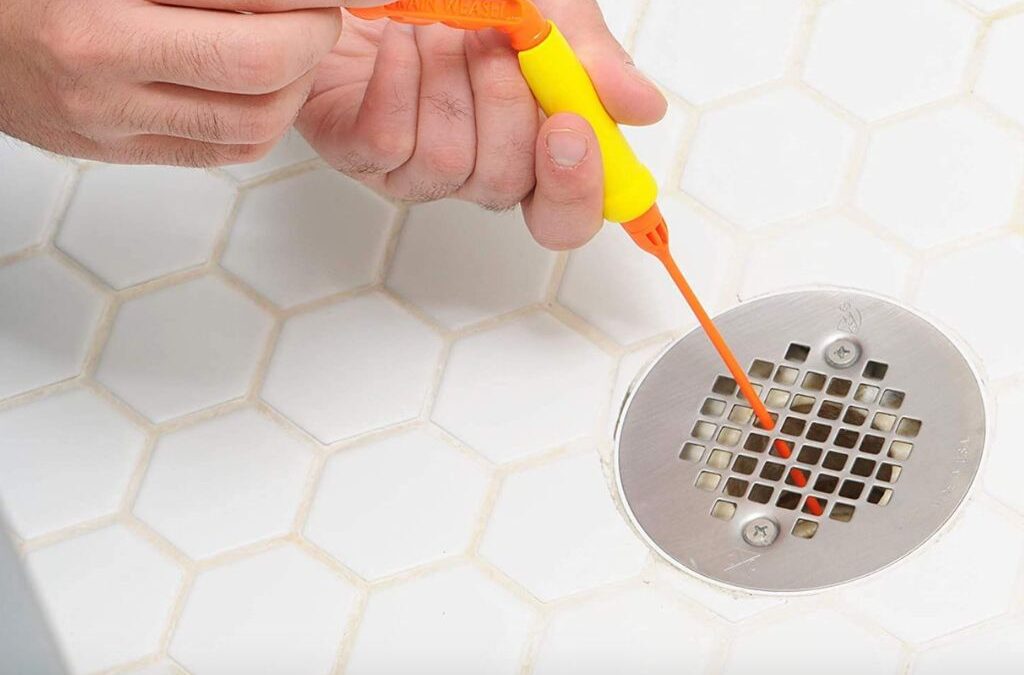
Step 3: Use a drain snake or hair removal tool
A cheap plastic hair clog remover – the kind with little barbs along the side – is genuinely one of the most useful things you can keep under the bathroom sink:
- Feed it down the drain
- Rotate it slowly
- Pull it back up.
You’ll usually bring up a surprising amount of buildup that was sitting just out of reach. For deeper blockages, a standard drain snake gives you more reach and more torque.
Step 4: The bicarb & vinegar method
Once you’ve cleared the physical debris, pour about half a cup of bicarbonate of soda directly down the drain, followed by half a cup of white vinegar. It’ll fizz – that’s exactly what you want.
Leave it for 15 to 20 minutes to break down grease and soap scum clinging to the pipe walls, then flush it through with a full kettle of boiling water.
This isn’t a magic fix for a serious blockage, but as a regular maintenance step it works well – and it’s completely drain-safe.
Step 5: How to clean a shower drain that can’t be removed
Some shower drains – particularly older ones or certain tile-flush designs – have covers that are effectively fixed in place. If you can’t get the cover off, you’re not out of options:
- A flexible drain snake can still be fed through the drain opening without removing the cover.\
- The bicarb and vinegar flush works just as well poured straight through the grate.
- And an enzymatic drain cleaner – available at most hardware stores – is worth keeping on hand for these situations, as it breaks down organic matter without the need for any physical access.
Step 6: How to clean a linear or long shower drain
Linear shower drains – the long, narrow channel style that runs along one edge of the shower – are increasingly common in Brisbane homes, and they come with their own cleaning considerations.
The channel cover on a linear drain usually lifts out in one piece, which makes access straightforward. The issue is the length of the channel itself, which collects hair and debris across a wider area.
How to clean long shower drain layouts?:
- A long-handled bottle brush works well for scrubbing the full length of the channel.
- Follow up with the bicarb and vinegar flush and you’re done.
Keeping the cover clear and rinsing the channel after each shower goes a long way toward preventing buildup in the first place.
Step 7: Flush & test
Run the shower for a minute and watch how the water drains. It should clear quickly and cleanly.
If it’s still sluggish after everything above, the blockage is likely sitting further down the pipe – beyond the reach of a standard drain snake – and that’s when it’s worth calling in a professional.
How often should you do this?
A quick hair removal after every couple of showers takes about 30 seconds and prevents most problems before they start. A full clean using the steps above every month or two keeps things flowing properly and means you’re unlikely to ever deal with a serious blockage in that drain.
When DIY isn’t enough
How did you go? Most shower drain blockages respond pretty well to the steps above. But you could be dealing with something a little trickier:
- Recurring slow drainage?
- Foul smells that won’t shift?
- Water backing up into other fixtures when you run the shower?
In these cases and plenty of others, the problem is probably deeper in your drainage system and probably the result of seriously blocked drains – and no amount of bicarb and vinegar is going to fix it.
That’s where the friendly team at Brisbane Drain Cleaning comes in. We use CCTV drain inspection cameras to find exactly what’s going on, and hydro-jetting and other pro solutions to clear it properly – with fixed pricing and same-day service across Brisbane.
Give us a call, and we’ll sort it out.
Related posts:
 7 Steps To Clear A Blocked Downpipe
 How To Fix A Slow Running Shower Drain? (And 3 Mistakes To Avoid)
 Wet Season Woes: Unblocking Shower Drains Amid The Showers
 6 Steps To Silence Your Gurgling Drains
 How To Use An Electric Eel Drain Snake Cleaner
 The Smell Test: Ranking Smelly Drains (And How To Fix Them)
